Hinabing Tala
Magdarame:
The Blood and Faith of Pampanga
By Philline Vallejos
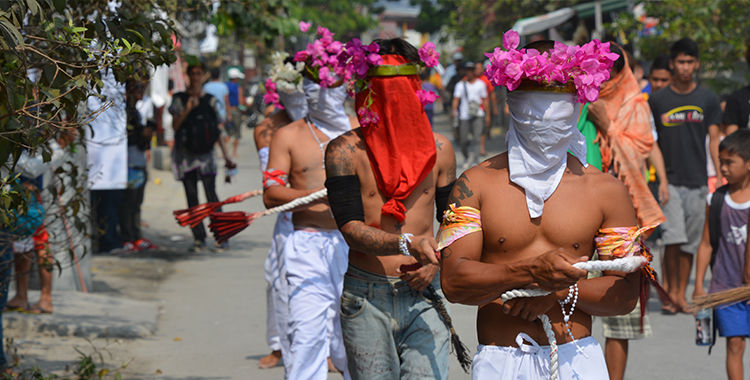
PAMPANGA, PHILIPPINES - The streets of Pampanga transform every Holy Week where the people traditionally come in hooded figures, known locally as magdarame (meaning “to share in sorrow” in kapampangan). People walk barefoot across towns, and their backs whipped by bamboo whips (bulyos) even when there is already blood and wounds; these devotees continue the practice all throughout their walk. While others carry heavy wooden crosses as they walk across different towns. These practices are century-old where it mixes between indigenous expressions of faith and Catholicism from the Spanish colonial era, which creates one of the most intense Lenten traditions in the Philippines. The rituals peak on Good Friday ending on 3 pm since Jesus dies at that time or it finishes once they finish the whole bible during the pabasa (L. Mercardo, personal communication, Month Day, 2025), notably in San Pedro Cutud, where some devotees really do actual crucifixion, which reenact the suffering of Christ before devotees and non-local onlookers.
The practice of magdarame centers on three acts of penance: pamalaspas (self-flagellation), where people use paddles with glass shards (panabad) to strike and cut the penitent’s back before the continuous whipping of bamboo sticks. Next, is pamumusan king krus (cross-bearing), where devotees carry large crosses and pamagsalibatbat (crawling on rough pavement), while being struck by people assisting them.
The tradition traces back to the 17th-century from Spanish Franciscan missionaries but popularized and done by casamacs (peasant farmers) who thought fasting and prayer is not enough for atonement. For many, they consider this as a panata, vow to earn divine intervention, express gratitude, show faith, or fulfill generational promises. Consequently, families support participants with local food like patulbad (rice cakes) and ginilu (coconut drinks) which helps in nourishing the devotees while still adhering to the restrictions in diet during lenten season.
Despite its deep cultural roots and a long standing tradition in Pampanga, the Catholic church labels it as “spiritual vanity” saying it’s important to do charity more than self-harm. Additionally, health officials warn of the possibility of infections and from the open wounds and heat stroke as this is during the summer season in the Philippines. Yet this tradition lives on, sustained by shared community practices and familial devotion. For Kapampangans, the bloodstains are a symbol of faith and forgiveness and redemption etched on their bodies.